Showing posts with label Anita Ratnam. Show all posts

Friday, January 4, 2008

Anita Ratnam stirs the intellect


Here is review of Anita Ratnam's new production , "“Faces – Blessed Unrest,”

One cannot assess a performance by Anita Ratnam like any other Bharatanatyam recital. If broken into its separate parts — the selected themes, the songs danced to, the use of the Bharatanatyam technique — it might seem no different generically from the kutcheri format. Surely, a deviation in the cut of the costumes alone would not suffice. So what makes her performances different? Perhaps the very fact that they make one think.

Most Bharatanatyam performances taking place today that are worthy of evaluation tend to fall into the category of devotional, spiritual, technically impressive, or plain entertaining. But few stir the intellectual faculties. Anita Ratnam succeeds in doing this, with her holistic approach to choreography, the spoken word, sets, lighting design and costumes.

Another way of categorising those concerns would be angika, vachika and aharya. Is it then, old wine in a new bottle? Yes, but with an honesty not associated with the phrase. Because the wine has been filtered every time. And it is the filter that gives a taste of freshness. So it was with her latest production “Faces – Blessed Unrest,” premiered at the Krishna Gana Sabha this past Friday.

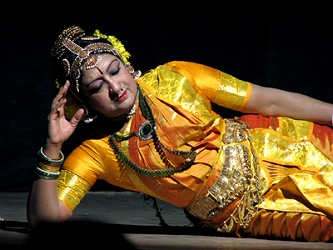
“Faces” is a collection of five of the most well known and beloved compositions from the devotional-classical tradition of Carnatic music. After a poetic introduction that was part of the soundtrack, the dancer began with ‘The Face of Compassion,’ introduced by the hymn to Annapurna, Nityanandakari, Varabhayakari, Soundaryaratnakari. Images of generosity represented by dance postures as well as literal actions like pouring of rice conveyed the spirit.

The dancer did not shy away from performing in complete silence at times — refreshing but all too rare in the contemporary classical dance scenario. The highlight of the piece was the beautifully sung Sama raga kriti “Annapurne Vishalakshi.”

The female voice rendering the Dikshitar composition was all that it should have been in terms of emotion and melody. The only jarring factor was the singer’s repeatedly pronouncing Vishalakshi as “Visalakshi”, which became an irritant, especially in a programme where attention to detail was high.

Another high point of the evening was ‘The Forgotten Face,’ represented by “Asai Mugam,” a Subramania Bharathi composition that melts the heart of the romantic and blurs the line between love and devotion. Here, seated on the floor, the dancer conveyed the wrenching lyrics with almost no mudras. It was a triumph of abhinaya, and of the seamless blending of dance, lighting and music. The English text, here and throughout the programme, by Aparna, was beautiful.

In ‘Timeless Faces’ the dancer told the entire Ramayana (“Tell me the story of infinite faces…”) against a voice alap and no lyrics, in the opposite approach to the previous song. It was a series of allusive images. The finale, ‘The Face of Blissful Surrender,’ was based on a Meera bhajan. The final image of an ecstatic Meera rising from the floor in an attitude of blissful expectation was effective.

Credit for the attractiveness of the package goes also to the soothing music score composed and arranged by pianist Anil Srinivasan, (assisted by associate music director Vedanth Bharadwaj). Srinivasan’s piano chords, fused unobtrusively with Carnatic classical, provided a moving ambience. Vocalists on the soundtrack included O.S.Arun, Sikkil Gurucharan, Revathy Sankkaran, Subhiksha Rangarajan. Light design was by Mithran Devanesan.

Costumes by Sandhya Raman were aesthetic, and, with the exception of the last, which resembled a gown, did credit to the trimmed down Anita. The last costume did not seem to gel with the movement vocabulary, and so neither did justice to the other.

Overall, the production, which could not rely on convention — a cushion available to standard format Bharatanatyam performances — may not have been comprehensible to an audience not at home with the songs. But it created some wonderful sound and light images and engendered a feeling of serenity.

From The Hindu review by Anjana Ranjan

Wednesday, January 2, 2008

Season Glimpses


Excerpts from Narthaki reviews by Lalitha Venkat

Bharatiya Vidya Bhavan is one organization that offers its programs free for rasikas during the Chennai season. Being centrally located, these shows naturally attract a full house on most days.

DEC. 12.
Gangani concluded his Kathak recital at 6.50pm and there was mayhem after that. The hall was already full by now and there were many wanting to come in to see Sudharani Raghupathy and her troupe of 22 perform MAMMUDHA – FROM DUST TO LIFE. Being a free program, most of the family and friends of the performers had come that day. As a volunteer blocked the door saying there was no place, there was a near stampede as people pushed the man aside and moved in, most of them having to settle to standing along the walls to watch the show!

It was an almost plain backdrop of grey panels broken by the face of a half man-half woman – maybe symbolizing that Manmadha was not all macho but a bit effeminate too (As Sudharani described her visualization of Manmadha at the press conference earlier). It was refreshing to see a new theme being enacted. Mammudha (as he’s known in rural South India) or Manmatha, the God of Love, at the behest of Lord Indra trained his arrow on the meditating Shiva, only to bear the brunt of Shiva’s third eye which reduced him to ashes. Moved by his inconsolable wife Rathi’s tears, Shiva promised her that Manmatha would come back to life, but be visible only to her eyes! Through diligent research, the whole story was composed into a 1hr 45 minute long presentation, with production, concept, soundscape and direction by the talented KSR Aniruddha, the son of Sudharani Raghupathy.

Priya Murle as Indra was brilliant in her Therukoothu style portrayal. She was such a natural that she almost stole the show. Sasirekha Balasubramanian as the Therukoothu Kattiyakaran narrator was engaging. Aruna Subbiah as the narrator in Bharatanatyam style seemed superfluous. A talented dancer like her could have been used in a more meaningful role. Anusha Venkatramani as Nandi made an imposing figure. TM Sridevi was a pretty Rathi and the gorgeous guru Sudharani was an elegant Manmadha. Celebrating 60 years of her career in dance, this is the first time she is taking on a male role. The dummy horse dancers did a neat job. The well presented show was testimony to all the hard work put in over the months, but a couple of scenes, especially the dialogue between Manmadha and Shiva could have been edited a bit. Costumes of Manmadha, Rati, the folk dancers, narrators, Indra and Nandi by V V Ramani were striking. Lighting by theatre veteran Mithran Devenesan added sparkle to the production that has been running to full houses this season!

DEC 13

Programs at the Bhavan generally adhere to timings and (so) was 5 items on SKANDA, one of the names of Lord Muruga or Subramanya, presented by students of Chidambaram Academy of Fine Arts, conceptualized by guru Chitra Visweswaran. Though she was invited to perform herself, she could not bring herself to do so, so soon after her husband Visweswaran’s demise, so she is presenting her students during the season. She still cannot contain her tears when she announces a composition of her late husband. It was a neat and compact one hour presentation with a plain backdrop broken by peacock feathers. The dancers included Uma Namboodripad, Arupa Lahiri, Ashmita Raghavan, Supriya, Nivedha, Shalu and Jai Quehani. The supporting orchestra comprised of Sukanya and Mridul Vivek on nattuvangam, Murali Parthasarathy on vocal, Adyar K Gopinath on mridangam, R Thyagarajan on flute, G Sitarama Sharma on violin and C Munuswamy on tanpura. It was good to see the full auditorium.

DEC. 25

Starting with an invocation to Lord Venkata, the devotee finds climbing uphill difficult but is re-energized on getting a darshan of Devi. Then follows a description of what he sees at Thirumala, the different vehicles of the Lord and the audience broke into rapturous applause especially when she pulled the chariot! After entering the sanctum, the devotee describes the 16 upacharams in “Shodashakalanidhikku.” An item on athma pooja where the beautiful description is about body being the temple, head being the kalasam and so on. “Bhavayami Gopala Balam…” that is synonymous with MS Subbulakshmi, followed by an item in sringara bhava on love between Perumal and Thayar. The swing song was composed in folk tune and so was the next item “Brahmam Okate.” As we were enjoying Padma’s mind boggling array of a myriad facial expressions for the one line, the power went off resulting in total blackout. But the orchestra continued playing, Padma stood where she was, keeping beat with her ghungroos and when the power came back on in about 3 minutes, they continued the item from where they left off! Because of the T Nagar area being such a mess now, I thought that the audience turnout of about 100 or so was fairly good, but my dance critic friend disagreed with me and was most annoyed that programs were being presented to near empty halls.

DEC.28
Anita Ratnam always premiers her new production of the season at Krishna Gana Sabha and so it was too this year, with FACES on Dec 28. It shows familiar and loved persona from our cultural tapestry, but through depicting them, Anita’s idea is to convey the dominant emotion connected with that personality. “These faces were already there – have always been,” says Anita. “But they have been recognized as personalities rather than emotions. So when you look at them just as faces, they become easier to relate to, the emotion becomes personal.” It is not thematic but it is a collection of her favourite dances that she had created, but never performed. Annapoorni is the face of compassion, Durga vanquishing Mahisha is the face of rage, the forgotten face is an exercise in abhinaya to “aasai mugam marandhu pochey” sung soulfully by Sikkil Gurucharan to Anil Srnivasan’s plaintive piano notes, timeless faces from the Ramayana story uses an excerpt of the Ramayana alaap of Sikkil Gurucharan, Meera is the face of blissful surrender to OS Arun’s melodious rendition. The presentation uses lot of theatrical stage movement, and the backdrop with swinging bamboo poles is quite dramatic. Anil Srinivasan's musical arrangement uses traditional Carnatic music compositions sung as they are, not specifically tailor-made to suit set choreography or stage directions, so Anita’s choreographic inputs uses its natural flow. What is striking in the soundscape of Faces, are moments of stark silence. “The silence allows the mind to ponder, and form a coherent thought before being rushed into the next face/movement. The dance lies ultimately in the rasanabhuti of silence,” explains Anil.

he beautiful costumes have been designed by Delhi based Sandhya Raman. The idea is to bring out the classical grace of the feminine image without the heavy embellishment of traditional costumes. The costumes have been created with wraps and drapes, so the main tussar-toned basic costume is combined with green, chrome yellow or copper gold wrap, to facilitate lightning change for each item to reflect the respective emotion. The crystal-studded organza Benaras cutwork like a flowing Sufi costume for the final item is absolutely stunning. Long time collaborator Mithran Devanesen directs the lights and joining the team is dramaturg Aparna, who has worked with contemporary dance theater in Germany.

Considering that Krishna Gana Sabha is the most affected venue thanks to the messy flyover construction work in T Nagar, a fairly good number attended the program. Says Anita, “Since I danced NEELAM on Vaikunta Ekasasi day last year, Mr. Yagnaraman was so appreciative. He was so open minded and always encouraged my endeavors. I dedicate my work this year to his memory. Do you know, an organizer would not offer me a slot for ‘Faces’ since it had ‘Christian’ music?” Strange are the ways minds work!

Thursday, November 29, 2007

Madras and Mudras

Here is an article by Anita R Ratnam which I hope you will enjoy as much as I did:-

"As a teenager, I would stagger out of bed bleary-eyed and face another day of school and dance classes with Rajee Narayan. My Arangetram in 1964 was at the Abbotsbury marriage hall (now the site of an abandoned hotel complex). The occasion was my uncle’s wedding reception.

The performance was two hours long and I was eight years old. Just five days earlier I had slipped down the stairs and hurt my back and could not bend like Kumari Kamala (an inspiration for an entire generation to learn Bharatanatyam) in the snake dance! I was crushed but tried to make it up with my Ava Gardener smile. After five costume changes applause, my father rushed backstage and scolded my guru for making me sweat so much!

I remember tailor Aiyyelu coming to our present home on Cenotaph Road to take measurements. My sister Pritha and I danced together whenever she decided she could divert her mind from her first rank in class exams. My mother Leela was an innovator in colours and costume design and created several outfits that Aiyyelu understood with his quicksilver mind.

Performances were always exciting. An assortment of celebrities sat in the front row . My mother or one of my gurus, Adyar K Lakshman and Madurai N Krishnan, would pop in informing me about the various VIPs who arrived but all I wanted to know was ‘‘Has Subbudu come? Has NMN come?’’ The two dreaded dance critics of Indian Express and The Hindu.

December 1971. The greats MS and Bala in the audience and me backstage. The occasion. The opening session of the annual Music Academy Conference and a dancer appearing after several years to open the session. Years later. The morning prayer under the banyan tree at Kalakshetra with Atthai (Rukmini Arundale) and Sankara Menon attending. Dreaded 'araimandi’ sessions with Sarada Hoffman and lovely dance classes with Neila Sathyalingam and Jayalakshmi teacher. A stern Atthai summoning me and asking me to take part in one of the famed Ramayana dance dramas as Kausalya — mother to Janardhan sir’s famous Sri Rama. Heart fluttering each time I had to repeat a movement and Sarada teacher barking “innum ukkaaranum ( you have to sit lower)” until my long legs could hardly make it out of the class sessions.

Dance means Madras. Sweat. Heat. Sound of wood on wood. Tamil, English and Malayalam melting in the sweltering heat. Paint, lights, applause or walk outs. Reviews and gossip sessions with Sruti magazine’s Janaki. Mylapore, North Mada Street, checking out new costume jewellery at Sukra.

Today. New costumes planned for a new production on the Lotus. The land phone and the mobile ring simultaneously. My kids yell their annual mantra, “Amma! Please leave your dance for one December and come with us on a holiday.” My mother looks at my wall filled with awards and honours and calmly declares, “All okay, but when are you getting your Padma Shri?” "

Source: New Indian Express (Click for more)